As Amazon Associates, we earn from qualifying purchases. This means we may receive a small commission at no extra cost to you if you click through and make a purchase.
The Phoscon ConBee II is a dedicated universal Zigbee 3.0 USB gateway engineered by dresden elektronik to coordinate smart home peripherals locally without tethering your household to external servers. Designed to plug straight into a desktop, notebook, Raspberry Pi, or mini-PC, it bridges disparate smart devices into a unified network managed entirely within your living room. Our assessment confirms that for households seeking dependable, subscription-free smart home management that keeps working even when your broadband connection drops, this compact adapter stands out as one of the most reliable and future-proof investments available.
This gateway is an ideal match for families and tech-conscious homeowners who value digital privacy, zero ongoing subscription charges, and the freedom to mix hardware from varied manufacturers across a single wireless mesh. Because it functions entirely as a local coordinator, family routines such as motion-activated lighting, safety notifications, and climate automation run with immediate responsiveness and zero data harvesting. However, individuals looking for a turnkey, standalone appliance with a built-in AC wall plug and proprietary one-click mobile software will likely prefer a commercial cloud gateway, as this hardware requires an always-on host machine and some initial platform configuration.
Phoscon ConBee II at a Glance

| Attribute | Detail |
|---|---|
| Brand | Phoscon |
| Manufacturer | dresden elektronik |
| Model Number | BN-600107 |
| Hardware Interface | USB |
| Wireless Protocol | Universal Zigbee 3.0 |
| Data Transfer Rate | 3 megabits_per_second |
| Dimensions | 2.36″L x 0.71″W x 0.35″H |
| Item Weight | 8 g |
| Supported Operating Systems | Not listed |
| Supported Automation Platforms | deCONZ, Phoscon App, Home Assistant, ioBroker, Zigbee2MQTT |
Local Control and Privacy Architecture
The defining strength of the Phoscon ConBee II is its absolute independence from third-party servers. When building an automated household, routing sensor data through distant server farms introduces multiple failure points, ranging from internet outages to discontinued cloud support. The conbee ii local control model eliminates these vulnerabilities by keeping every automation trigger, schedule, and state change within your local network boundary. When a child opens a door or a temperature sensor flags an overheated room, the command reaches your lighting or ventilation gear immediately, bypassing internet latency altogether.
Data privacy is another substantial benefit for family living environments. Standard commercial smart hubs frequently demand user profile registrations, ongoing telemetry collection, and continuous connection to company clouds. By contrast, the Phoscon ConBee II requires no user account, no cloud connectivity, and zero external registration. Whether you pair basic light bulbs or monitor room occupancy using a smartthings presence sensor, your presence patterns and daily habits remain strictly confined to your home hardware. This design protects your family against remote service shutdowns and security breaches that plague internet-dependent consumer hubs.
Local communication also delivers tangible performance improvements in daily operation. Cloud-dependent hubs introduce noticeable lag between physical trigger and automated response, which can be frustrating when family members expect light switches to respond instantly. Because the gateway routes Zigbee transmissions directly to your chosen automation engine, command execution feels instantaneous. The lack of internet dependence ensures that core safety alerts and daily schedules run consistently, even during major internet service provider outages.
Software Integration and Platform Versatility
Flexibility across multiple open-source platforms is a primary reason the conbee ii for home assistant continues to be a staple choice for custom home automation setups. Rather than locking the user into a proprietary mobile application, dresden elektronik provides native compatibility with an extensive software suite. Users can run the manufacturer’s dedicated deCONZ and Phoscon App environment, or bridge directly into popular open automation platforms like Home Assistant, ioBroker, or Zigbee2MQTT. This broad adaptability allows homeowners to choose whichever user interface and scripting engine best matches their technical comfort level.
Unlike brand-restricted bridges like the phillips hue hub pro, which are engineered primarily around a specific ecosystem, the Phoscon ConBee II operates as a vendor-neutral transceiver. It captures low-level Zigbee packets and delivers them cleanly to the controlling software stack. This means your family is not trapped within a single brand’s product catalog. You can easily link door sensors from one manufacturer, radiator thermostats from another, and wall switches from a third, managing every component through a single, cohesive dashboard that you control.
Software maintenance is straightforward, with firmware update tools provided directly by dresden elektronik across its supported operating systems. The listing details operating system support for Windows 7, Windows 10, Ubuntu Linux (AMD64), Raspbian for micro-computing boards, and containerized deployments via Docker. This wide platform support means you can deploy the gateway on an existing household desktop, a repurposed laptop, or a dedicated, low-power Raspberry Pi running quietly in a utility closet.
Signal Range and Hardware Specifications
Physical construction and radio performance are critical metrics for any wireless network coordinator. Looking closely at the conbee ii specs, the device measures a compact 2.36 inches long, 0.71 inches wide, and 0.35 inches high, weighing a featherlight 8 grams. Encased in a durable black plastic shell with an integrated USB connector, it occupies minimal physical space. Internally, the hardware features a built-in power-amplifier that boosts transmission and reception capability across typical household barriers such as drywall, floors, and interior doors.
The conbee ii range benefits noticeably from this integrated amplifier, enabling stable direct communication with distant endpoints across multi-room layouts. In standard Zigbee network topology, mains-powered devices like smart plugs and hardwired switches also function as repeaters, relaying signals throughout the home. Starting your network with an amplified coordinator provides a strong, reliable baseline that prevents initial packet loss during device pairing and maintains steady links with sleeping battery-powered sensors.
One operational detail highlighted in the specifications is the data transfer rate of 3 megabits per second over the USB data link protocol. While 3 Mbps is modest compared to high-speed storage interfaces, it is significantly wider than the bandwidth required for Zigbee transmissions, which operate on small, low-overhead data frames. However, because USB ports—particularly USB 3.0 sockets on modern computers—can emit radio frequency noise that interferes with 2.4 GHz wireless networks, positioning the ConBee II on a short USB extension cable rather than directly against a computer chassis is standard practice to preserve maximum signal clarity.
Setup Workflow and Device Pairing Management
Setting up the phoscon conbee ii setup workflow depends largely on the operating environment you select. For users preferring a visual, graphical approach, installing deCONZ and launching the browser-based Phoscon App on a Windows desktop or Ubuntu machine provides an accessible entry point. The software automatically identifies the USB gateway, initiates the Zigbee network, and allows you to initiate device discovery with a simple click. The interface visually represents your wireless mesh, illustrating link qualities and signal paths between nodes.
For smart home enthusiasts managing an integrated home server, passing the USB gateway into a Docker container or Home Assistant instance is well-documented and officially supported. The stick mounts as a serial device, allowing automation frameworks to communicate directly with the radio. Once integrated, conbee ii zigbee compatibility covers thousands of diverse accessories across various global brands, handling smart bulbs, wireless buttons, humidity monitors, and smart plugs without needing individual brand hubs plugged into your wall outlets.
Pairing hardware is handled through standardized inclusion procedures. Putting the Phoscon software into pairing mode and activating the physical pairing pin on your endpoint sensor typically establishes the connection within seconds. Devices are identified, categorized by their capabilities, and mapped into functional groups or rooms. Because the device table is retained through host reboots, your family will not experience disconnected accessories or network drops following a routine computer restart or system update.
Long-Term Value and Multi-Brand Interoperability
Evaluating the phoscon conbee ii usb gateway from an economic and practical standpoint highlights substantial benefits for household budgets over time. Commercial smart home ecosystems frequently lock consumers into proprietary hardware bridges. When comparing the conbee ii vs tuya hub options, commercial cloud hubs often limit connectivity strictly to their specific brand ecosystem and rely entirely on external mobile servers. If the manufacturer updates app terms, changes server policies, or drops cloud maintenance for older devices, your hardware can become obsolete overnight.
Because the Phoscon ConBee II adheres strictly to universal Zigbee 3.0 communication standards, it frees you from single-vendor dependency. When you find a reliable Zigbee smart switch or sensor on sale, you can integrate it into your existing network regardless of the manufacturing label on the package. Over years of home ownership, this broad interoperability saves substantial money by letting you source components based on physical build quality and pricing rather than ecosystem branding.
So, is conbee ii worth it for an average family home? If your priority is longevity, local data integrity, and avoiding subscription creep, the answer is an unqualified yes. While the initial setup requires more attention than plugging in a simple consumer appliance, the long-term return in operational stability, zero monthly overhead, and total data privacy makes it an exceptionally strong foundation for household automation.
Phoscon ConBee II Pros and Cons
Pros
- Completely local operation without cloud dependence
- Wide cross-manufacturer Zigbee 3.0 device integration
- Integrated power-amplifier for extended signal range
- Native support for Home Assistant, deCONZ, and Docker
- Lightweight and compact 8-gram USB stick design
Cons
- Requires an always-on host PC or Raspberry Pi
- Limited to 3 megabits per second USB transfer rate
- Does not function as a standalone plug-in hub
Who Should Buy the Phoscon ConBee II
Buy It If
- You want complete local smart home automation that operates without internet access, subscription fees, or account registrations.
- You run or plan to deploy Home Assistant, Docker, Raspbian, Ubuntu, or Windows on a local home server or personal computer.
- You intend to mix Zigbee accessories from multiple manufacturers across a single, unified wireless mesh.
- You value family privacy and prefer keeping home sensor telemetry and routines strictly inside your local network.
Skip It If
- You want a standalone, plug-and-play hub that plugs directly into a wall outlet without requiring a host computer or Raspberry Pi.
- You do not want to manage local software installations or platform configurations on a computer.
- You only purchase devices from a single proprietary brand and prefer using that brand’s pre-packaged mobile application.
Phoscon ConBee II Alternatives Worth a Look
If your smart home setup requires a different hardware format or you prefer an off-the-shelf appliance that does not need an external computer host, consider these alternatives from the same category.
Smart Multi-Mode Gateway
Our score: 8.6/10
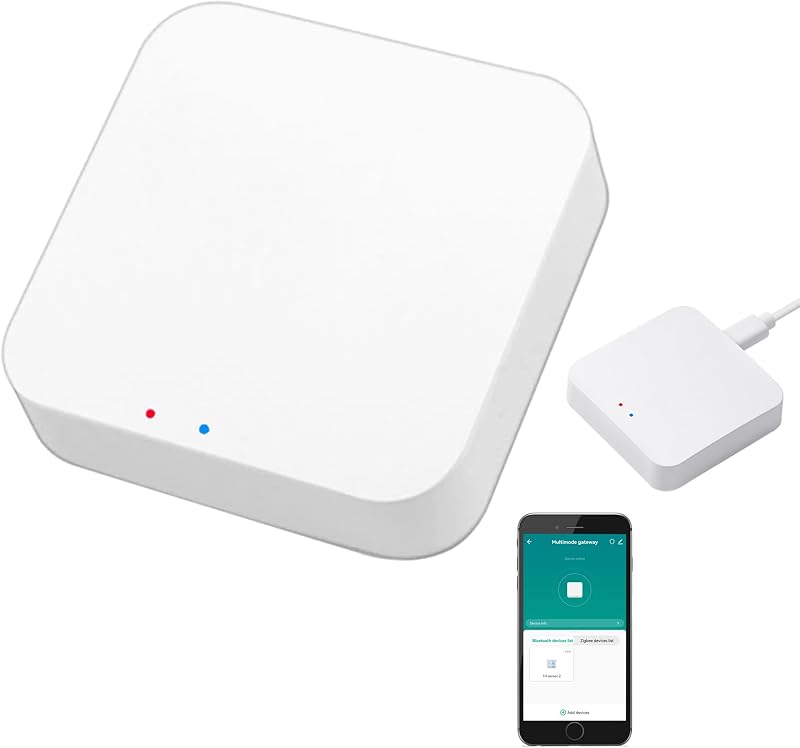
The Smart Multi-Mode Gateway is an all-in-one wireless bridge supporting Zigbee 3.0, Bluetooth, and mesh networking with app remote control and voice control through Alexa and Google Home. Unlike the ConBee II, this device explicitly only supports Tuya smart devices, making it suited exclusively for shoppers committed entirely to that specific platform who want direct mobile app control out of the box.
Remote control via Tuya Smart
Our score: 8.8/10

The Remote control via Tuya Smart gateway is a standalone, white 2.4GHz wireless Zigbee 3.0 hub designed specifically for pairing Tuya ecosystem devices with long-range connection support. Buyers who want an independent, self-contained desktop bridge rather than a USB adapter for a computer host will find this an easier, albeit brand-restricted, alternative.
MOES ZigBee & Bluetooth &
Our score: 8.2/10

The MOES ZigBee & Bluetooth & bridge combines Zigbee, Bluetooth, and mesh protocols inside an independent hub designed to work specifically with the Smart Life and MOES mobile applications. It is tailored for households that focus strictly on Tuya-compatible devices and want smartphone-first management without running home automation server software.
Final Verdict
The Phoscon ConBee II represents one of the most capable and dependable investments available for building a durable, private smart home. By stripping away cloud dependencies, required user logins, and vendor ecosystem restrictions, dresden elektronik has delivered a universal coordinator that puts homeowners in total command of their automation networks. Its integrated power-amplifier ensures reliable wireless coverage across the household, while native support across Windows, Linux, Raspbian, and Docker provides the freedom to host your network on almost any existing computer hardware.
While it requires an always-on host machine and a moderate amount of initial setup compared to branded consumer hubs, the rewards in daily speed, resilience against internet failures, and broad device compatibility are unmatched. For families seeking a long-term automation backbone that respects privacy and keeps monthly operational expenses at zero, the Phoscon ConBee II is an outstanding choice that will serve your household reliably for years to come.
FAQ
What host hardware is required to operate the Phoscon ConBee II?
The gateway requires an available USB port on a host computer such as a standard desktop PC, notebook, Raspberry Pi, or mini-PC running supported operating systems including Windows 7 or 10, Ubuntu Linux (AMD64), Raspbian, or Docker environments.
Does the Phoscon ConBee II require an active internet connection?
No, the gateway is an entirely local solution. It does not require internet connectivity, cloud servers, or online user registration to control paired smart home devices, meaning your automations continue running even if your home broadband goes down.
Which automation platforms can control the Phoscon ConBee II?
The device listing confirms compatibility with the manufacturer’s deCONZ and Phoscon App software, as well as leading open home automation systems including Home Assistant, ioBroker, and Zigbee2MQTT.
What is the data transfer rate of the USB interface on this gateway?
The listing specifies a data transfer rate of 3 megabits per second over its USB hardware interface, which provides ample throughput for coordinating low-bandwidth Zigbee sensor and switch packets.
Can the Phoscon ConBee II connect Zigbee products from different brands?
Yes, it is designed as a universal Zigbee 3.0 gateway that integrates Zigbee-certified products across different manufacturers into a single local network, eliminating the need to keep separate proprietary brand hubs plugged in.


