As Amazon Associates, we earn from qualifying purchases. This means we may receive a small commission at no extra cost to you if you click through and make a purchase.
The Anycubic Wash and Cure 3 is a dedicated desktop post-processing machine engineered to streamline the messy, multi-step process of cleaning and secondary curing for resin 3D prints. Rather than forcing hobbyists to rely on separate plastic tubs of volatile solvents and makeshift ultraviolet lamps, this integrated station combines fluid agitation washing and 405nm light curing inside a single compact frame. Its core verdict is clear: it provides an exceptionally reliable, tidy, and repeatable post-processing routine that dramatically reduces chemical exposure and resin tackiness while optimizing part strength.
This post-processing station is an ideal fit for home hobbyists, miniature painters, and family makerspaces running light-curing desktop printers with build plates up to 7.3 inches. It suits users who prioritize straightforward mechanical operation, quieter wash cycles, and reduced alcohol evaporation over industrial complexity. However, print shops producing massive architectural batches or users running large-format production machinery will find its dedicated chamber dimensions limiting and should seek commercial-scale equipment.
Anycubic Wash and Cure 3 at a Glance

| Attribute | Specification Detail |
|---|---|
| Brand and Manufacturer | ANYCUBIC |
| Model Designation | Wash and Cure 3 |
| Primary Materials | Polycarbonate (PC) and metal |
| Product Color | Multi-color |
| Listed Dimensions | 30″D x 20″W x 20″H |
| Listed Product Weight | 0.28 g (per manufacturer listing) |
| Printer Size Compatibility | LCD 3D printers up to 7.3 inches |
| Platform Adjustment Heights | Dual levels at 100 mm and 165 mm |
| Supported Platform Range | 5.9 inches to 7.3 inches |
| Timer Range | 1 to 30 minutes adjustable |
| Auxiliary Curing Source | Flexicure gooseneck light (+30,000uW/cm² within 1-3 cm) |
Washing Basket Capacity and Solvent Efficiency
Managing liquid isopropyl alcohol safely is the biggest operational hurdle in any home resin printing workshop. The Anycubic Wash and Cure 3 addresses this by offering an upgraded cleaning bucket volume and a 42% increase in cleaning basket capacity compared to the older Wash and Cure 2.0. This expanded space is tailored directly for models produced by light-curing LCD 3D printers sized at 7.3 inches or smaller. The additional volume allows users to clean larger monolithic miniatures, complex architectural prints, or multiple tabletop terrain pieces simultaneously without crowding models together or risking delicate support breakage.
A standout engineering touch is the double-layered basket constructed from durable polypropylene (PP) material. This basket incorporates dual adjustable hanging positions at 100mm and 165mm, allowing users to suspend printing platforms between 5.9 inches and 7.3 inches directly over the solvent container. If you run a compact workhorse like the anycubic photon mono, you can wash parts while still adhered to the build plate. This height adjustability ensures that users do not need to fill the entire washing container to maximum capacity for smaller prints, conserving significant volumes of expensive solvent and minimizing overall chemical vapor production.
For family environments and small maker spaces, solvent conservation is as much about safety as it is about thriftiness. The sealed bucket design keeps hazardous fumes contained during high-speed agitation, preventing accidental spills that frequently happen when manually sloshing models in open plastic containers. By combining substantial internal capacity with height-adaptable immersion, the station delivers an organized resin wash and cure station workflow that keeps chemicals locked down and off craft tables.
Curing Uniformity and Flexicure Gooseneck Lighting
Secondary ultraviolet curing is essential for converting sticky, green photopolymer prints into rigid, touch-safe plastic objects. The Wash and Cure 3 introduces an improved optical core featuring a revised bead arrangement paired with a dedicated lens light source. This system generates a 20% improvement in curing uniformity over the preceding 2.0 model. Balanced light distribution across the rotating turntable prevents common post-curing defects, such as uneven tensile shrinkage, brittleness on one face, or remaining tacky patches on areas shielded from direct vertical light beams.
To tackle stubborn blind spots, this model incorporates ANYCUBIC’s Flexicure gooseneck light design. When positioned within an irradiation range of 1 to 3 cm, this flexible auxiliary light delivers an intense energy value increase of 30,000uW/cm². Standard turntable arrays shine horizontally and from below, which often leaves top surfaces, undercuts, miniature garment hems, and detailed hair textures under-cured. With this directional gooseneck lamp, makers can focus concentrated ultraviolet radiation straight into deep recesses and intricate figure overhangs.
This targeted illumination is especially valuable for collectors and painters who need pristine surface prep before applying acrylic primers. An under-cured crevice can slowly weep uncured resin over weeks, ruining paint layers and creating chemical contact risks. The wash and cure 3 gooseneck light solves this chronic resin printing failure point without requiring makers to hold unsafe handheld UV torches near their hands.
Noise Optimization and Intuitive Setup Controls
Shared creative spaces and family hobby rooms demand equipment that operates quietly without intrusive motor whine. ANYCUBIC tackled this requirement through a closed structural design combined with software optimization that dampens the cleaning motor’s operational noise. Even during vigorous solvent vortexing cycles, the station suppresses resonance, making it unobtrusive enough to run in a spare bedroom, garage, or shared study without disturbing household activities.
Simplicity governs the user interface. Dual cleaning and curing modes are selectable with a single click, removing the guesswork often found on machines with cluttered, non-intuitive menus. The flexible gooseneck light can be toggled on or off with its own dedicated one-click control, while a smooth timer allows users to dial in run times from 1 to 30 minutes. Whether giving a fragile miniature a gentle two-minute bath or running a dense mechanical gear through a twenty-minute cure, selecting parameters takes seconds.
This streamlined interface makes the unit an appealing candidate for the best wash and cure station for beginners. Initial anycubic wash and cure 3 setup requires minimal effort: you simply position the base, place the appropriate container or curing plate, connect power, and begin processing. Creators who regularly work with filament printers such as the anycubic kobra s1 combo will find the transition to resin post-processing straightforward thanks to these clean, barrier-free controls.
Durability, Materials, and Physical Footprint
The construction of post-processing hardware must withstand constant exposure to harsh industrial solvents and ambient resin drips. The Anycubic Wash and Cure 3 is built from a blend of polycarbonate (PC) and metal components. The rugged yellow cover shields bystanders by blocking harmful ultraviolet rays during curing cycles, while simultaneously preventing ambient room light from curing resin left inside printer vats nearby. The chemical-resistant PP washing basket shows zero degradation when exposed to extended alcohol baths.
Reviewing the anycubic wash and cure 3 specs reveals a listed dimension footprint of 30 inches deep by 20 inches wide by 20 inches high. The listing records a weight figure of 0.28 g, which is an obvious manufacturer catalog data error rather than physical reality, as the robust metal and PC build provides a stable, anchored desktop presence. Shoppers should measure their workbench space carefully before unboxing, ensuring adequate vertical clearance above the unit to lift the protective UV hood off smoothly.
While the machine handles LCD prints up to 7.3 inches with ease, users should recognize its clear hardware boundaries. Makers running oversized industrial resin platforms, such as an anycubic mono m7 max, will find their build plates exceed the physical perimeter of this cleaning basket. For mid-range and entry-level desktop resin printers, however, the station strikes a balanced middle ground between physical footprint and functional internal volume.
Practical Value and Everyday Workflow Efficiency
When evaluating whether the Anycubic Wash and Cure 3 is worth it, buyers must weigh time savings and safety against the cost of manual labor. Washing prints by hand using pickle jars and toothbrushes consumes significant shop time, increases chemical spill risks, and leads to messy worktables. Automating this chore into a repeatable, enclosed cycle protects family members from skin contact with liquid photopolymers and keeps airborne fumes inside a sealed environment.
In market comparisons like the anycubic wash and cure 3 vs elegoo mercury matchups, the inclusion of the Flexicure gooseneck light and the 42% larger basket capacity give the Anycubic unit a noticeable functional edge. The two-tier hanging basket eliminates solvent waste, allowing users to stretch their alcohol reserves across multiple print projects. For anyone running frequent print runs, those solvent savings quickly offset equipment costs over a year of steady printing.
This honest anycubic wash and cure 3 review highlights a machine designed around real hobbyist workflows rather than paper specifications. It transforms the messiest, most avoided part of resin 3D printing into an orderly ten-minute task that delivers consistently hard, dry, and safe prints ready for handling, display, or immediate painting.
Anycubic Wash and Cure 3 Pros and Cons
Pros
- Expanded 42% larger washing basket capacity
- Targeted Flexicure gooseneck light for crevices
- Dual-height basket saves cleaning solvent
- Uniform 20% enhanced UV curing array
- Quiet operation with one-click mode controls
Cons
- Limited to printers 7.3 inches or smaller
- Sequential rather than simultaneous wash and cure
- Substantial desktop footprint requiring dedicated space
Who Should Buy the Anycubic Wash and Cure 3
Buy It If
- You own an LCD resin 3D printer with a screen size of 7.3 inches or smaller and want automated cleaning.
- You print intricate tabletop miniatures, figures, or jewelry requiring concentrated curing in deep crevices.
- You work in a home workshop or family makerspace where quiet operation and enclosed solvent containment matter.
- You want to conserve isopropyl alcohol by adjusting basket heights to match smaller platform sizes.
Skip It If
- You operate large-format commercial resin printers with build platforms exceeding 7.3 inches.
- You only operate filament extrusion 3D printers that have no need for wash basins or UV curing lamps.
- You require simultaneous washing and curing cycles running at the exact same instant in separate chambers.
Anycubic Wash and Cure 3 Alternatives Worth a Look
While the Wash and Cure 3 provides balanced performance for mid-sized setups, comparing alternative post-processing options helps ensure you select the best hardware configuration for your workbench.
Perfect for Mars Photon S
Our score: 9.8/10
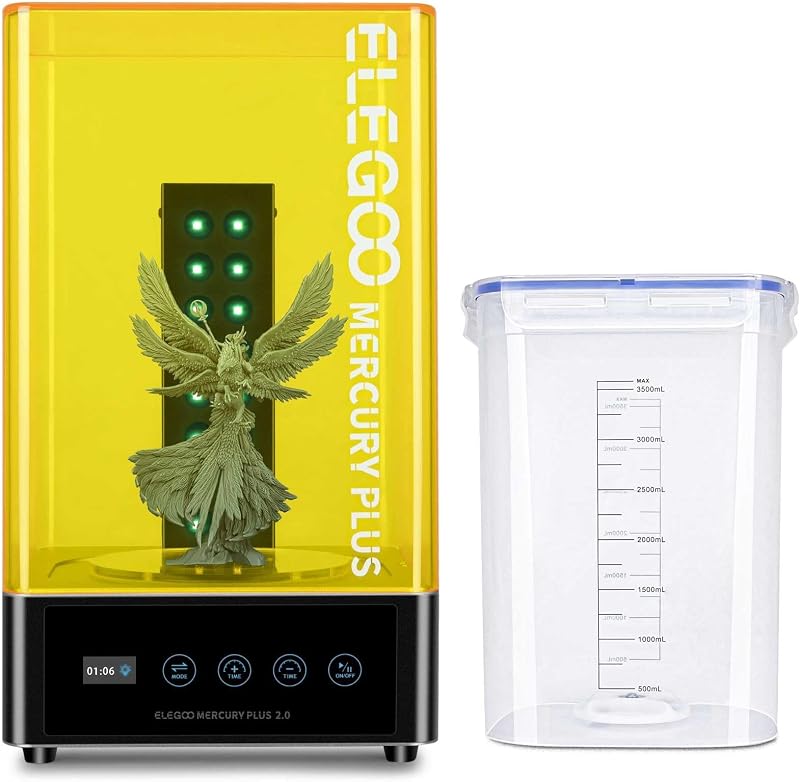
The Perfect for Mars Photon S is an ELEGOO Mercury Plus 2.0 wash and cure station configured with a designated washing size of 5.16″ × 3.54″ × 8.66″. Hobbyists who primarily produce tall, slender models and need more vertical cleaning height rather than horizontal volume will find this form factor well aligned with their prints.
Upgraded 2 in 1 Design
Our score: 9.4/10

The Upgraded 2 in 1 Design unit, also part of the ELEGOO Mercury Plus 2.0 line, features a 5.16 × 3.54 × 8.66-inch washing bucket paired with a UV resin curing box. Makers seeking a traditional dual-function unit for compact desks and entry-level resin machines can consider this variant as an alternative.
ELEGOO Mercury Plus 2.0 Wash
Our score: 9.2/10

The ELEGOO Mercury Plus 2.0 Wash station integrates a classic rotary curing turntable and a washing bucket for LCD, DLP, and SLA prints. Shoppers who prefer a standard rotational turntable approach without extra auxiliary gooseneck lights can consider this dependable alternative.
Final Verdict
The Anycubic Wash and Cure 3 succeeds by turning the most tedious and messy aspect of desktop resin printing into an organized, reliable process. Its 42% expanded basket capacity accommodates standard mid-sized models, while the two-tier platform heights conserve cleaning solvent. Combined with a 20% boost in curing uniformity and the innovative Flexicure gooseneck lamp for recessed areas, it delivers consistently thorough post-processing across delicate models.
For home makers, educators, and miniature enthusiasts operating LCD printers up to 7.3 inches, this station delivers substantial value, cleaner workbenches, and increased safety. As long as your print sizes stay within its specified platform envelope, it remains one of the most practical and user-friendly post-processing investments you can add to your workshop.
FAQ
How does the Flexicure gooseneck light improve resin curing?
The Flexicure gooseneck light increases ultraviolet energy output by 30,000uW/cm² within a close 1 to 3 cm range. By positioning this flexible arm directly over model tops, drapery hems, and hollowed crevices, users eliminate curing blind spots that standard horizontal turntable arrays cannot reach.
What build plate sizes fit directly into the washing basket?
The unit supports printing platforms ranging from 5.9 inches to 7.3 inches. The double-layered PP basket features two height adjustments at 100mm and 165mm, allowing users to suspend build plates directly into the solvent for hands-free washing.
How do you switch between washing and curing modes?
Operating modes are controlled through a simple one-click selection interface. Users switch between washing and curing with a single button press, toggle the gooseneck auxiliary light with one click, and adjust the operational timer anywhere from 1 to 30 minutes.
Can the machine wash and cure models at the same time?
The listing outlines dual cleaning and curing modes within a single base station, meaning operations run sequentially rather than concurrently. Users wash parts in the sealed container first, allow them to dry, and then swap in the curing plate to finish the model.
How does the station reduce operating noise in home spaces?
The machine utilizes a closed structure design combined with software motor optimizations. This construction dampens agitation vibrations during the wash cycle, keeping operational noise low enough for shared family workspaces.