As Amazon Associates, we earn from qualifying purchases. This means we may receive a small commission at no extra cost to you if you click through and make a purchase.
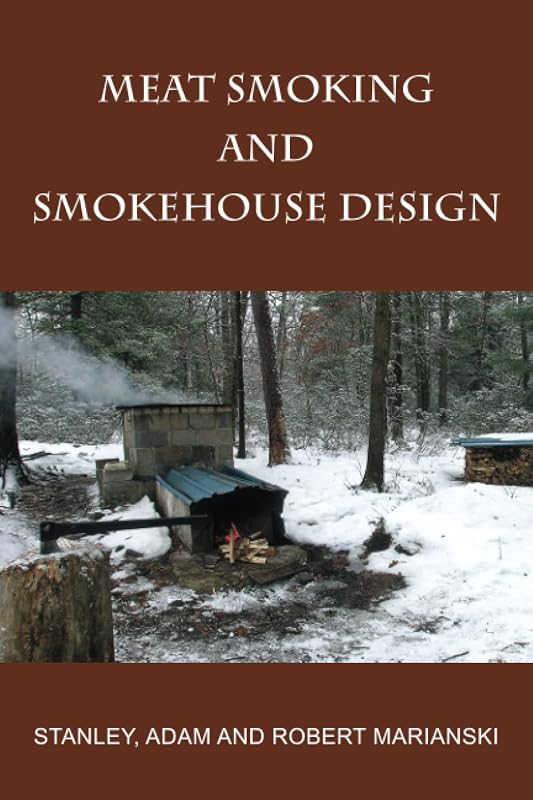
Meat Smoking and Smokehouse Design is an exhaustive 338-page technical manual dedicated to the mechanical principles of smoke generation, thermal management, and traditional meat preservation. Rather than filling its pages with glossy food photography and step-by-step marinades, this reference volume serves as an unapologetically scholarly blueprint for constructing functional smokers and mastering curing science from the ground up. In a market flooded with lightweight cookery pamphlets, this text stands apart as an authoritative engineering manual delivering definitive clarity for building serious backyard curing infrastructure.
This volume caters specifically to property owners, homesteaders, and self-reliant cooks who demand total control over their thermal environments and wish to design long-lasting preservation setups from scratch. Readers looking for quick weeknight barbecue recipes, plug-and-play digital smoker tips, or standard grilling marinades will find the heavy technical prose and mechanical calculations excessive and should look elsewhere.
Meat Smoking and Smokehouse Design at a Glance
| Attribute | Detail |
|---|---|
| Title | Meat Smoking and Smokehouse Design |
| Publisher | Bookmagic LLC |
| Publication Date | March 20, 2012 |
| Edition | 3rd ed. |
| Format and Length | Paperback, 338 pages |
| Language | English |
| ISBN-10 | 0982426704 |
| ISBN-13 | 978-0982426708 |
| Item Weight | 1.15 pounds |
| Dimensions | 6 x 0.77 x 9 inches |
Smokehouse Construction Plans and Structural Materials
The centerpiece of this manual lies in its exhaustive architectural guidance for custom fabrication. The text breaks away from generic advice by providing actionable, step-by-step diy smokehouse construction plans that cover five distinct structural categories: masonry units, portable chambers, traditional wooden sheds, poured or block concrete installations, and converted metal drum smokers. Instead of treating these builds as interchangeable decorative boxes, the authors systematically analyze the structural behavior, thermal retention capacity, and longevity of each material. This allows builders to choose an approach that aligns with their local climate, available acreage, and family processing volume.
Masonry and concrete designs receive serious structural analysis, emphasizing foundation stability, firebrick lining integrity, and the thermal mass needed to sustain even temperatures over extended curing cycles. For homesteaders who require movable equipment, the coverage of portable rigs and drum builds demonstrates how to optimize interior volume while preserving rigid airflow controls. Readers who currently rely on compact indoor alternatives like the camerons stainless steel stovetop smoker will discover how large-format, free-standing outdoor smokehouses operate on entirely different thermal scales, requiring calculated firebox placement to prevent radiant hotspots from ruining delicate cured products.
Every structural section functions as a traditional smokehouse design guide that emphasizes durable craftsmanship. By detailing proper framing techniques for timber smokehouses, the text ensures wood-lined chambers avoid internal moisture accumulation and dangerous creosote condensation. The authors explicitly connect physical dimensions to functional performance, illustrating how flue diameter, combustion box distance, and roof pitch dictate smoke dispersion. This methodical engineering focus transforms construction from an intimidating guessing game into a predictable building project that yields professional-grade results.
Technical Food Science and Meat Curing Theory
Where standard smoking manuals quickly pivot to sweet glazes, this meat curing and smoking technical book anchors its instruction in biochemical theory and food microbiology. The authors take a firm philosophical stance: understanding the physiological changes that occur inside muscle tissue during curing and thermal processing is far more crucial than memorizing pre-set recipes. Readers are walked through the underlying chemistry of curing salts, moisture loss metrics, microbial inhibition, and the exact role that wood smoke compounds play in preserving shelf-stable proteins. This baseline knowledge guarantees safety when processing large batches of heritage pork or wild game.
Sausage preparation occupies a critical role in the curriculum, establishing the physics of emulsion, grinding temperatures, casing permeability, and proper casing stuffing density. By dissecting why curing failures happen, the book empowers cooks to troubleshoot stalled fermentation, fat rendering, or uneven smoke uptake before an entire harvest is lost. Much like processing shelf-stable goods with a presto 23 quart pressure canner, mastering curing protocols requires strict adherence to temperature-time thresholds, and this book ensures those principles are non-negotiable across every project.
The recipe philosophy remains intentionally austere to foster culinary self-reliance. A curated section provides foundational formulas to establish core ratios, but the surrounding instruction trains readers to balance salinity, nitrate levels, sugar, and smoke exposure independently. Once the biochemical mechanisms are understood, developing customized regional charcuterie, dry-cured hams, or smoked sausages becomes a straightforward exercise in adjusting mathematical percentages rather than following someone else’s kitchen notes.
Thermodynamics: Grilling, Barbecuing, and True Smoking Distinctions
A major strength highlighted throughout this meat smoking and smokehouse design review is the authors’ rigorous differentiation between grilling, barbecuing, and authentic smoking. Commercial marketing frequently blurs these terms, causing novice backyard cooks to subject delicate meats to high convective heat when low-temperature dehydration is required. The text establishes rigid technical definitions for direct thermal radiation (grilling), low-and-slow convective rendering (barbecuing), and cold versus warm smoke application (smoking), explaining the thermodynamic profile and equipment configuration demanded by each.
Airflow engineering forms the backbone of the operating chapters. The book examines natural draft generation, explaining how intake damper positioning, combustion chamber sizing, and exhaust flue height balance pressure differentials within the smoking compartment. Readers who have struggled with stale, soot-laden flavors in basic plug-in appliances like the little chief smoker will learn how laminar airflow and positive draft mechanics prevent creosote deposition, yielding clean, translucent smoke that preserves meat without leaving a harsh chemical bitterness.
Fuel source combustion chemistry is analyzed with identical academic rigor. The authors explain how differing wood species, internal moisture contents, and oxidation temperatures generate specific chemical fractions within wood smoke, such as phenols and carbonyls. By mastering the operational variables laid out in these chapters, smokehouse operators can tailor their heat output and smoke density to suit delicate cold-smoked fish, semi-dry fermented sausages, or heavily smoked whole primal cuts with total predictability.
Blueprint Usability and Diagram Clarity
Visual instruction represents a substantial portion of the volume, backed by over 200 construction diagrams, technical schematics, and documentary photographs. These graphics move past vague artistic sketches, supplying dimensioned section cuts, damper assembly details, and firebox ducting paths. The inclusion of clear meat smoking and smokehouse design diagrams allows builders with moderate carpentry or masonry skills to translate raw lumber, concrete block, or sheet metal into fully functioning thermal structures without hiring specialized contractors.
The diagrams excel at revealing internal mechanics that external photographs cannot capture. Exploded views demonstrate how offset fireboxes link to vertical smoking towers via subterranean or angled flues, detailing the slope required to induce natural thermal draft while cooling the smoke volume for true cold-smoking regimens. Masonry layouts indicate proper brick overlap patterns and lintel placements, preventing structural failure under intense, repeated heating and cooling cycles.
While the visual schematics are technically comprehensive, they demand careful reading and spatial visualization. Novice builders will not find modern color-coded illustrations or simplified modular snap-together plans; the presentation reflects industrial shop drawings and black-and-white field schematics. For those willing to invest the study time, these blueprints provide an uncompromising, field-tested guide to fabricating permanent infrastructure that outlasts commercial sheet-metal cookers by decades.
Meat Smoking and Smokehouse Design Pros and Cons
Pros
- Over 200 construction diagrams and technical illustrations
- Detailed plans for masonry, wood, concrete, and drum smokers
- Rigorous focus on meat science and sausage curing theory
- Clear differentiation between grilling, barbecuing, and smoking
- Substantial 338-page technical reference volume
Cons
- Minimal collection of pre-made cooking recipes
- Scholarly tone requires intense study over casual reading
- Focuses primarily on custom fabrication rather than commercial units
Who Should Buy Meat Smoking and Smokehouse Design
Buy It If
- You want complete, multi-material blueprints to build a permanent masonry, wood, concrete, or drum smokehouse on your property.
- You prioritize food preservation science, sausage-making microbiology, and curing chemistry over superficial cooking recipes.
- You need to master natural draft mechanics, airflow engineering, and thermal management to achieve flawless curing results.
- You prefer a dense, academic reference manual that teaches you how to construct your own preservation formulas independently.
Skip It If
- You are seeking an entry-level barbecue cookbook filled with glossy meal photographs, quick dry rubs, and backyard dinner ideas.
- You exclusively operate digital pellet grills or automated commercial cabinets and have no interest in manual fabrication.
- You find black-and-white structural schematics, engineering calculations, and dense academic text difficult to digest.
Final Verdict
When asking is meat smoking and smokehouse design worth it, the answer depends entirely on your operational goals. For self-reliant families, serious homesteaders, and dedicated charcuterie crafters, this volume is an irreplaceable technical asset. By prioritizing engineering fundamentals, thermodynamics, and the underlying chemistry of meat preservation, it cuts through the consumer marketing that dominates the smoking hobby. It empowers property owners to build permanent, high-efficiency smokehouses suited to large processing runs while eliminating safety risks through strict scientific instruction.
However, readers looking for a breezy, recipe-driven introduction will quickly find the material overwhelming. The book deliberately bypasses commercial convenience in favor of foundational craftsmanship and deep theoretical mastery. If you are prepared to invest the mental effort into understanding the meat smoking and smokehouse design specs, this 338-page manual will serve as the definitive construction and curing blueprint for decades of successful food preservation.
FAQ
Does Meat Smoking and Smokehouse Design include ready-to-use recipes?
The book includes a basic recipe section designed to establish fundamental curing and seasoning ratios, but it is not a recipe book. The authors focus primarily on technical theory and curing science so that readers gain the skills necessary to safely create their own customized recipes.
What smoker types are covered in the construction blueprints?
The manual provides detailed construction diagrams and instructions covering five primary smokehouse designs: masonry installations, wood-framed sheds, poured or block concrete structures, converted steel drum smokers, and portable field units.
How suitable is Meat Smoking and Smokehouse Design for beginners?
While beginners can learn safe food-handling practices from the ground up, the text is dense, scholarly, and heavily focused on engineering and biological theory. Casual cooks wanting simple weeknight barbecue techniques may find the technical depth challenging without prior interest in fabrication or food science.
Does the book explain the difference between cold and hot smoking?
Yes. The book dedicates substantial instruction to defining the operational and thermodynamic differences between direct grilling, convective barbecuing, warm smoking, and low-temperature cold smoking, detailing how airflow and equipment design impact each process.
What are the physical dimensions and specifications of this edition?
This volume is the 3rd edition, published by Bookmagic LLC on March 20, 2012. It contains 338 English pages in a paperback format, weighs approximately 1.15 pounds, and measures 6 by 0.77 by 9 inches.


