As Amazon Associates, we earn from qualifying purchases. This means we may receive a small commission at no extra cost to you if you click through and make a purchase.
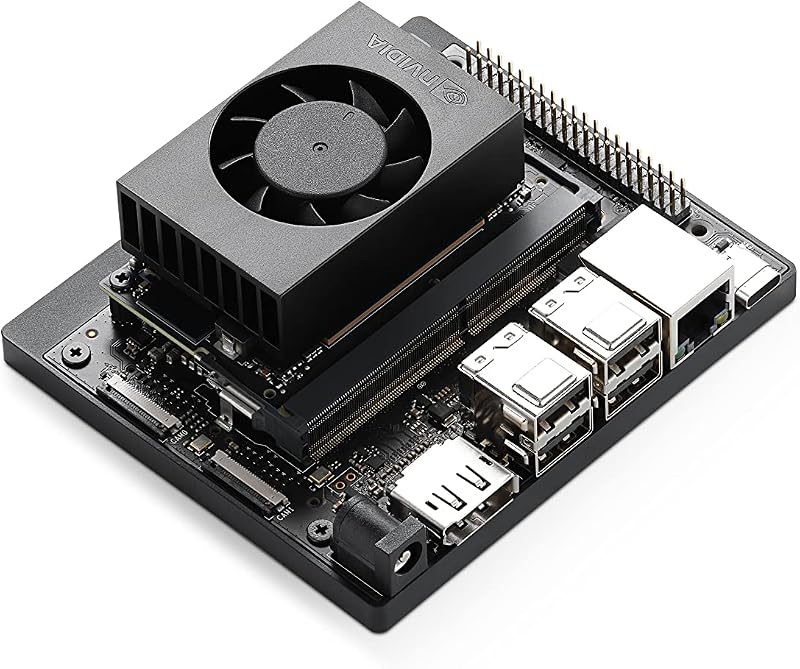
The NVIDIA Jetson Orin Nano Developer Kit is an entry-level computing module engineered to deliver advanced edge artificial intelligence capabilities in a compact form factor. By pairing an Ampere architecture graphics processing unit with a 6-core ARM processor, this single-board computer brings machine learning inference, vision processing, and neural network execution directly to local hardware without requiring continuous cloud connectivity. For families, students, and makers building forward-looking technical skills, it stands as an uncompromising foundation that delivers production-grade compute power right to your workbench.
This developer kit is ideal for hobbyists, STEM students, and robotics enthusiasts who want hands-on experience with production-level AI frameworks and autonomous systems. If your household or educational workshop seeks to explore deep learning, computer vision, and physical computing, the hardware provides exceptional longevity that will not become obsolete after simple script experiments. However, users who merely require basic microcontroller automation for simple sensors, or those seeking an immediate consumer appliance that functions without command-line setup, should explore less complex alternatives.
NVIDIA Jetson Orin Nano at a Glance
| Attribute | Detail |
|---|---|
| Processor | 6-core ARM Cortex-A78AE v8.2 CPU |
| Graphics Architecture | NVIDIA Ampere GPU |
| Memory | 8 GB LPDDR4X RAM |
| Storage Capacity | 8 GB installed storage capacity |
| AI Compute Performance | Up to 40 TOPS (up to 67 TOPS on Super series) |
| USB Connectivity | 5 total USB ports |
| Networking and Wireless | Ethernet, Bluetooth wireless compatibility |
| Display and Expansion | DisplayPort, General Purpose Input/Output (GPIO) headers |
| Operating System | Linux |
| Dimensions | 6 inches long, 3 inches wide, 8 inches high |
Edge Computing and AI Processing Capabilities
The standout feature of the hardware is its computational density. Evaluating the jetson orin nano dev kit specs reveals an architecture that mirrors commercial edge computing solutions. Powered by an Ampere graphics processing unit alongside a 6-core ARM Cortex-A78AE v8.2 central processor, the system produces up to 40 TOPS of compute power in standard deployments, reaching up to 67 TOPS in enhanced configurations. This level of jetson orin nano ai performance allows the board to process complex generative models locally, handling vision transformers, large language models, and vision-language networks that would overwhelm typical single-board hardware.
Running neural networks directly on local hardware gives learners and developers an enormous advantage. Rather than offloading sensor telemetry and image feeds to remote data centers, the system carries out real-time inference on the device. This on-device processing drastically reduces latency, prevents network bandwidth bottlenecks, and keeps private sensor data inside the home network. When designing autonomous projects, having local access to Ampere-accelerated tensor operations ensures immediate object classification, path planning, and obstacle negotiation.
For educational builds, the 8 GB LPDDR4X memory configuration provides the necessary working headroom to run modern deep learning frameworks without immediate memory exhaustion. Makers integrating customized robotic bodies often fabricate structural mounts using a 3d printer elegoo neptune 4 plus to anchor the module alongside high-resolution sensors. Because the board handles heavy computational workloads locally, it remains responsive even when parsing multi-stream camera feeds and running simultaneous background tasks.
Carrier Board Versatility and Hardware Durability
The foundation of this system is the nvidia jetson orin nano carrier board, a reference platform engineered for modular longevity. Rather than soldering compute elements directly to the peripheral interface board, the system houses the processor on a dedicated module. This reference carrier board accommodates all Orin Nano and Orin NX modules, which means the underlying interface platform remains viable if you choose to swap compute cores in future project iterations.
Physical peripheral expansion is extensive. The system incorporates five USB ports, giving developers ample connectivity for depth cameras, lidar units, external input peripherals, and storage expansions. Network access is supported by onboard Ethernet alongside Bluetooth connectivity, while standard DisplayPort output manages monitor feeds. A comprehensive General Purpose Input/Output header allows direct signaling with motor controllers, relays, and external microcontrollers, making the jetson orin nano 8gb developer kit a central hub for complex physical hardware setups.
Physical longevity is a major concern for family workshops and student laboratories. Measuring 6 inches long, 3 inches wide, and 8 inches high, the board features sturdy component soldering, durable header pins, and a robust mounting arrangement for thermal cooling solutions. The resilient architecture withstands repeated reconfigurations, sensor re-wiring, and integration into mobile chassis where movement and minor impacts are inevitable.
Software Ecosystem and Robotics Applications
Hardware power is meaningless without mature software, and the unified nvidia jetson software stack sets this development platform apart from bare-metal boards. Running on an enterprise-ready Linux operating system, the platform grants immediate access to modern developer toolchains, containerization software, and hardware-accelerated computer libraries. This native Linux foundation provides real-world engineering familiarity for students preparing for computer science and robotics careers.
For physical builds, employing the jetson orin nano for robotics unlocks specialized acceleration environments. The developer kit supports NVIDIA Isaac for autonomous robotics engineering, DeepStream for vision AI video pipelines, and Riva for conversational artificial intelligence. Furthermore, the ecosystem integrates NVIDIA Omniverse Replicator for synthetic data generation, allowing students to train artificial intelligence models using simulated environments before testing them on physical machinery.
To sustain complex projects over months of experimentation, maintaining clean physical builds is just as important as writing clean code. Keeping workshop accessories such as a no clogger 3d printer tool ready ensures rapid maintenance of custom 3D-printed sensor brackets and electronics enclosures. Backed by extensive ecosystem partner support for specialized camera sensors and custom carrier boards, the platform never limits your project scope as software complexity grows.
Setup Experience and Family Educational Value
A frequent question among parents and educators is whether the jetson orin nano for beginners is manageable. The out-of-the-box package includes a Quick Start and Support Guide, along with both Type B and Type I power cables to suit different outlet configurations. The initial jetson orin nano setup requires configuring the Linux environment and flashing operating system images, which introduces learners to fundamental concepts of modern system administration and edge deployment.
While the initial setup involves a steeper learning curve than simple graphical microcontrollers, the educational payoff is significantly higher. Students learn how device trees, hardware buses, package managers, and software dependencies interact within a genuine UNIX environment. Instead of artificial toy environments, learners work directly with professional developer tools, building skills that translate directly into industrial computing, robotics engineering, and academic research.
When asking is jetson orin nano dev kit worth it for a family workshop, the answer lies in its multi-year lifespan. Simple hobby boards are often abandoned once basic lights and motors are programmed, but the Jetson Orin Nano platform supports years of gradual skill acquisition. A student can begin with basic Python scripting and GPIO switching, progress into OpenCV image processing, and ultimately train and deploy custom generative models without ever maxing out the hardware.
NVIDIA Jetson Orin Nano Pros and Cons
Pros
- Up to 67 TOPS AI processing performance
- Ampere GPU with 6-core ARM CPU architecture
- Carrier board accommodates Orin Nano and Orin NX modules
- Five USB ports for extensive peripheral connectivity
- Comprehensive NVIDIA AI software stack support
- Native Linux environment for real-world development skills
Cons
- Steeper learning curve requiring Linux familiarity
- Onboard storage limited to 8 GB capacity
- Overkill for simple microcontroller sensor automation
Who Should Buy the NVIDIA Jetson Orin Nano
Buy It If
- You want to build autonomous robots, smart drones, or AI-powered vision cameras requiring high-speed local processing.
- You want a durable hardware investment supported by the comprehensive NVIDIA AI software stack, including Isaac and DeepStream.
- You value modular development boards that allow swapping between Orin Nano and Orin NX compute modules.
- You want students or family members to gain hands-on experience with professional Linux development and real-time edge AI.
Skip It If
- Your projects only require simple sensor readings, environmental monitoring, or basic motor toggling.
- You prefer a plug-and-play appliance that operates without configuring Linux or working in terminal environments.
- You are seeking an ultralight, battery-sipping microcontroller for simple wearable electronics.
NVIDIA Jetson Orin Nano Alternatives Worth a Look
While the Jetson platform excels at demanding edge AI calculations, simpler projects often benefit from smaller, low-power microcontroller boards designed for focused automation tasks.
ESP-WROOM-32 ESP32 ESP-32S Development Board
Our score: 8.8/10

The ESP-WROOM-32 ESP32 ESP-32S Development Board is a compact microcontroller unit featuring a 2.4GHz dual-mode Wi-Fi and Bluetooth processor. Compatible with the Arduino IDE and incorporating an integrated antenna with RF AMP filters, this board handles basic connected tasks with minimal power consumption.
Shoppers who want to build straightforward wireless sensor nodes, smart light switches, or simple connected home appliances should select this option over the Jetson. It eliminates complex operating system overhead and provides an immediate, low-overhead way to learn fundamental C++ hardware programming.
Low-power IoT Applications
Our score: 9.4/10

The Low-power IoT Applications board package from ELEGOO provides three ESP-32 dev boards equipped with ESP-WROOM-32 processing, USB-C connectivity, Bluetooth 4.2, and accessible GPIO headers. It is explicitly tailored for lightweight smart devices, basic automation, and straightforward wireless communication.
This multi-pack suits makers who need to scatter multiple inexpensive sensor nodes across a workshop or home. If your goal is to automate garden watering or monitor garage door positions without running heavy computer vision models, this kit delivers the necessary connectivity without the processing complexity of an edge AI computer.
2Pcs Raspberry Pi Pico Development
Our score: 8.6/10

The 2Pcs Raspberry Pi Pico Development package features the RP2040 dual-core ARM Cortex M0+ processor running up to 133 MHz. It comes equipped with 2MB Quad SPI flash, support for C, C++, and Python, and an integrated interface for SPI, I2C, and UART communications.
Families introducing young children to text-based coding via MicroPython will appreciate the simplicity of the Raspberry Pi Pico. It provides a frustration-free entry point for learning how software loops interact directly with physical hardware pins before graduating to an advanced computational system like the Jetson.
Final Verdict
The NVIDIA Jetson Orin Nano Developer Kit establishes a high standard for desktop-accessible edge artificial intelligence. By combining a 6-core ARM CPU, an Ampere GPU, and 8 GB of memory on a versatile reference carrier board, the system brings genuine industrial-grade capabilities into educational spaces and home laboratories. Its ability to execute generative AI, vision transformers, and multi-camera pipelines locally sets it entirely apart from standard hobby boards.
For tech-focused families and makers seeking long-term hardware durability and practical learning value, this platform provides an unmatched launchpad. It requires an investment of time to master its Linux operating environment, but the payoff is direct fluency with production robotics frameworks and modern edge computing. If you want a platform that grows alongside your technical ambitions, this developer kit is well worth bringing to your workbench.
FAQ
What operating system does the NVIDIA Jetson Orin Nano run?
The developer kit runs on the Linux operating system, providing a robust terminal environment, native package management, and full compatibility with standard developer toolchains and containerized applications.
How much AI processing performance does the board deliver?
The system provides up to 40 TOPS of AI compute performance in standard developer configurations, with enhanced Super platform specifications delivering up to 67 TOPS to handle demanding generative AI models locally.
What power accessories are included in the package?
The package includes a Quick Start and Support Guide along with two specific regional power cords: a Type B cable for US and JP outlets, and a Type I cable for CN outlets.
Can the reference carrier board be upgraded with other modules?
Yes, the included reference carrier board is designed to accommodate all Orin Nano and Orin NX modules, allowing developers to interchange modules as processing requirements evolve.
How many USB ports are available for peripheral connectivity?
The platform provides a total of five USB ports, allowing you to connect multiple peripheral accessories such as external storage drives, depth cameras, input devices, and networking accessories simultaneously.


