As Amazon Associates, we earn from qualifying purchases. This means we may receive a small commission at no extra cost to you if you click through and make a purchase.
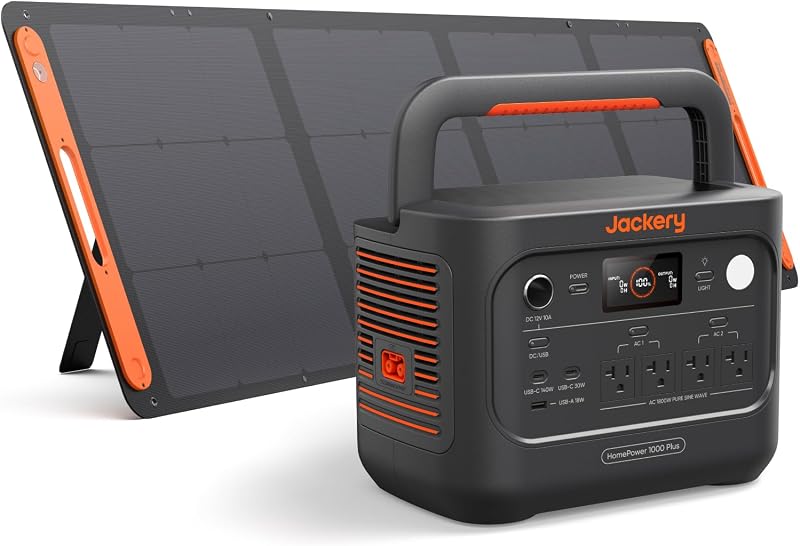
The Jackery Solar Generator 1000 Plus combines a durable 1024Wh lithium iron phosphate base unit with a high-efficiency 200W solar panel to deliver a balanced, enduring clean energy source for emergency preparedness and outdoor adventures. Engineered around an 1800W continuous output, an assertive 3600W starting surge capacity, and ultra-fast automated switchover capabilities, this portable energy system provides dependable household resilience without the exhaust, noise, or maintenance demands of traditional combustion generators.
This solar generator setup suits suburban homeowners and active families requiring uninterrupted backup protection for medical equipment, kitchen refrigerators, home networking hardware, and remote workstations during utility blackouts, as well as vehicle campers demanding clean off-grid electricity. Shoppers seeking an ultra-compact power bank for casual day hikes or those looking to power an entire central HVAC system straight out of a single unexpanded chassis will want to explore different capacity tiers.
Jackery Solar Generator 1000 Plus at a Glance
| Specification | Detail |
|---|---|
| Model Name and Number | Jackery HomePower 1000 Plus (JHP-1000B) |
| Rated Running Wattage | 1800 Watts |
| Surge Peak Wattage | 3600 Watts |
| Battery Capacity | 1024Wh Base Capacity (Expandable to 11kWh) |
| Battery Chemistry | Ceramic-Coated LiFePO4 |
| Cycle Lifespan | 6000 Cycles to >=70% Capacity |
| AC Outlets | 4 Outlets across 2 Independently Controlled Circuits |
| Direct Current Output | 140W USB-C High-Speed Port |
| UPS Transfer Speed | Under 10 Milliseconds with 3kV / 1000J Surge Protection |
| Product Dimensions | 12.3″L x 7.9″W x 9.3″H |
Battery Durability and Long-Term Cell Lifespan
Long-term value in portable power stations depends fundamentally on internal cell chemistry, and this unit utilizes industrial-grade lithium iron phosphate (LiFePO4) cells coated in protective ceramic. The technical design yields a rated cycle life of 6000 charge cycles before the internal storage degrades to 70 percent of its original capacity. When evaluated under standard residential conditions where a family might cycle the battery through routine outdoor excursions and seasonal blackout preparation, this rated endurance translates to roughly a decade of stable service life without substantial capacity fade.
Thermal stability sets these ceramic-coated cells apart from earlier lithium compositions. The internal battery management architecture preserves functional operation in cold environments down to 14°F (-10°C), preventing the sudden voltage drop-offs and cold-weather charging lockouts that frequently disable off-grid systems in winter. For families living in regions prone to severe ice storms and sub-freezing grid collapses, the robust chemistry ensures the battery retains and discharges its energy reliably when indoor temperatures plummet.
The structural layout pairs this dense chemical safety with a compact chassis measuring 12.3 inches long, 7.9 inches wide, and 9.3 inches high. Housing over a kilowatt-hour of energy in a footprint smaller than a standard milk crate protects sensitive internal busbars while keeping the total mass manageable for single-person transit. This durable physical and chemical integration addresses the primary concern of long-term owners who need hardware that will not degrade while sitting in a storage closet between storm seasons.
Power Delivery and Smart Circuit Management
Supplying electricity during an emergency involves balancing total current draw against sensitive microelectronics, and the 1800W continuous output rating delivers sufficient headroom for demanding residential appliances. With a starting wattage threshold of 3600 watts, the pure sine wave inverter absorbs the initial motor inrush spike generated by heavy inductive loads, such as full-size kitchen refrigerators, sump pumps, and power tools. Sensitive desktop computers, monitors, and television displays receive smooth, distortion-free current that prevents hardware damage and unexpected thermal resets.
The central innovation of the output array is its smart load management system, which divides the four AC outlets into two independently controlled electrical circuits. Through this system, users can designate vital appliances to a primary circuit while running non-critical secondary conveniences on the other. By assigning an automated battery shut-off threshold to the secondary circuit, the power station automatically severs power to non-essential loads when the energy reserve drops to a predetermined level, reserving remaining watt-hours strictly for mission-critical hardware.
In addition to standard AC wall receptacles, the station incorporates high-speed direct-current distribution, headlined by a 140W USB-C output port. This dedicated connection charges modern laptops, mobile phones, and portable communications gear without running the internal AC inverter, avoiding unnecessary conversion losses. Integrating smart circuit rationing alongside pure sine wave distribution delivers calculated control over household reserves rather than draining capacity indiscriminately.
Home Backup Performance and Emergency Preparedness
When utility lines fail during severe storms, transfer speed determines whether sensitive household electronics remain operational or suffer abrupt shutdowns. Operating as an uninterruptible power supply (UPS), the station continuously routes pass-through utility electricity to connected equipment while maintaining an active standby link to its internal battery. In the event of a grid interruption, the system executes an automated switchover in under 10 milliseconds, ensuring desktop computers, Wi-Fi routers, CPAP machines, and smart home hubs stay powered without resetting.
Grid instability often introduces destructive electrical spikes before a total outage occurs, and this unit includes integrated 3kV / 1000J surge protection to suppress dangerous transient voltages. By filtering grid anomalies before they reach connected devices, the unit functions as an active electrical shield during lightning storms and grid switching events. Readers tracking hardware updates in our jackery explorer 1000 v2 coverage will appreciate how dedicated surge suppression hardware enhances equipment survivability in volatile residential environments.
Managing ongoing electrical demands requires realistic calculations regarding runtime across typical household loads. The base 1024Wh capacity operates an efficient 60W portable refrigerator or modern Energy Star household fridge for roughly 12 to 15 hours of intermittent cycling, while running a home office setup consuming 100 watts continuously for approximately 8 to 9 hours. Understanding these baseline operating hours allows families to prioritize critical tasks during short outages or plan solar replenishment routines during multi-day grid collapses.
Solar Recharging and Outdoor Utility
Renewable replenishment separates temporary battery banks from genuine emergency generators, and this bundled package supplies a 200W solar panel alongside a heavy-duty 8020-to-solar connector cable. Setting up the solar array enables off-grid families to capture sunlight during extended disruptions or remote overland trips, transforming the unit into a self-sustaining power station. The included connection hardware links directly to the station without requiring aftermarket adapters or specialized electrical tools.
Regarding solar input speed, the manufacturer documentation confirms the panel wattage and connector interface, though the listing does not specify the exact total charging hours required to take the station from empty to full under real-world conditions. Solar harvest efficiency naturally fluctuates according to cloud coverage, seasonal sun angle, and ambient temperature, but feeding a consistent 200W theoretical input significantly shortens daytime recharge intervals compared to smaller panels. Those exploring panel configurations can reference our evaluation of the solarsaga 100w solar panel to understand how different wattage ratings impact replenishment logistics.
Beyond emergency utility in the home, the station proves exceptionally capable around campsites, RV trailers, and remote work sites. The clean pure sine wave power eliminates the lingering fumes, spark arrestor maintenance, and engine noise associated with fossil fuel generators, making it compliant with national park sound ordinances and quiet campground curfews. Four AC outlets permit simultaneous operation of camp lighting, cooking elements, and camera battery chargers while the solar array continually trickles replacement energy back into the LiFePO4 cells.
System Expansion and Smart App Connectivity
While the standard 1024Wh storage capacity handles short blackouts and weekend outings with ease, prolonged emergencies demand greater energy reserves. The architecture accommodates scalable modular expansion, enabling users to expand the base unit up to an immense 11kWh capacity by connecting up to five separate expansion battery packs. Because these additional battery units are sold separately, families can start with a manageable footprint and incrementally scale their backup reserves as household power requirements or emergency preparations expand.
Those who want to assess mid-range standalone generators alongside scalable hardware will find valuable perspective in our review of the jackery explorer 1500 v2 solar generator with 100w solar panel, which highlights how physical form factors shift when base capacities increase. The modular nature of this expandable platform ensures users are not locked into a single fixed capacity, providing a viable upgrade path toward multi-day whole-home resilience without replacing the primary control unit.
System oversight is simplified via integrated Wi-Fi and Bluetooth connectivity, which pairs the power station directly with the Jackery App on a smartphone. The interface provides real-time telemetry displaying incoming solar wattage, outgoing load consumption, and remaining operational hours down to individual percentages. Users can remotely toggle specific circuit ports, adjust AC charging intake rates to accommodate sensitive household wiring, and activate Energy Saving Mode to minimize idle vampire drain when operating low-wattage appliances overnight.
Jackery Solar Generator 1000 Plus Pros and Cons
Pros
- Durable 6000-cycle ceramic-coated LiFePO4 battery chemistry
- Sub-10ms UPS switchover with 3kV surge protection
- Smart load management across dual independent AC circuits
- High 1800W running and 3600W starting surge output
- Modular capacity expandable from 1024Wh up to 11kWh
- Included 200W solar panel and 8020 connector cable
Cons
- Modular expansion battery packs must be purchased separately
- Listing does not specify exact solar recharge hours
- Substantial physical footprint for casual ultralight excursions
Who Should Buy the Jackery Solar Generator 1000 Plus
Buy It If
- You need an automated household backup system featuring an under-10ms UPS switchover and 3kV surge suppression to shield home offices, CPAP devices, and networking gear.
- You prioritize long-term durability and seek a LiFePO4 battery chemistry rated for 6000 cycles and engineered for sub-freezing operational temperatures.
- You want a flexible, future-proof energy platform that starts at 1024Wh but can expand up to 11kWh with supplemental battery packs as family needs grow.
- You value smart load control that allows you to set automated cut-off parameters on non-essential AC circuits to preserve critical appliance runtimes.
Skip It If
- You are searching for a featherweight, pocket-sized battery pack exclusively meant for charging cell phones on light day hikes.
- You want a massive, immovable whole-home backup station straight out of the box without purchasing modular add-on battery packs.
- You prefer a system that integrates multi-panel solar arrays pre-wired into a single unified shipping frame.
Jackery Solar Generator 1000 Plus Alternatives Worth a Look
Shoppers surveying the portable power category often encounter varied power outputs and capacities tailored for specialized scenarios ranging from ultralight weekend travel to basic bedside emergency power.
Backup LiFePO4 Battery
4.0 out of 5, average from Amazon buyers

For buyers whose priorities center on lightweight mobility rather than multi-kilowatt household support, the Backup LiFePO4 Battery offers a compact 292Wh capacity based on the Jackery Explorer 300 series. It is geared directly toward outdoor camping, travel, hunting, and modest blackout duties where hauling a larger station is impractical. Readers interested in smaller grab-and-go form factors can examine our complete jackery explorer 300 breakdown for deeper performance insights on this compact platform.
GRECELL Portable Power Station 500W
4.5 out of 5, average from Amazon buyers

Users who require an intermediate tier of power without committing to high running wattages should look at the GRECELL Portable Power Station 500W. This alternative supplies a 519Wh battery capacity paired with two AC outlets and a 60W USB-C power delivery port. It serves as an accessible middle ground for weekend RV camping, modest tool charging, and light household emergency backup where heavy motor surges are not encountered.
Pure Sine Wave AC Outlet
4.8 out of 5, average from Amazon buyers

Shoppers seeking a dedicated, lightweight solution for bedside medical devices or modest outdoor trips should consider the ALLWEI 300W unit listed under Pure Sine Wave AC Outlet. This 256Wh LiFePO4 power station integrates MPPT solar charging management, built-in BMS protection, and a 60W USB-C port. Its modest output makes it well-suited for powering CPAP equipment, mobile phones, and camping illumination during overnight excursions.
Final Verdict
The Jackery Solar Generator 1000 Plus represents a thoughtfully engineered balance of durable chemical engineering, practical power delivery, and smart power rationing. By anchoring the platform with ceramic-coated LiFePO4 cells capable of 6000 cycles and sub-freezing discharge, this system eliminates the rapid degradation that plagued older lithium-ion generators. The addition of dual-circuit load management, pure sine wave power, and rapid under-10ms UPS automated switching gives households a dependable emergency defense against unpredictable utility interruptions.
While purchasing the expansion battery packs required to reach the full 11kWh ceiling requires planning, the base package delivers immediate, substantial utility right out of the box. Between the included 200W solar panel for quiet off-grid energy replenishment and the comprehensive real-time controls provided by the Jackery App, this generator stands as a dependable long-term investment for families seeking peace of mind, rugged build quality, and lasting electrical self-reliance.
FAQ
How long does the LiFePO4 battery pack last across years of routine use?
The internal ceramic-coated LiFePO4 cells are rated for 6000 complete charge cycles while maintaining at least 70 percent of their original capacity. For typical residential and outdoor usage where the unit is cycled regularly throughout the year, this chemical endurance provides approximately 10 years of reliable operating life before notable capacity fade occurs.
Can the system switch over fast enough to prevent a desktop computer from turning off during a blackout?
Yes, the station features an integrated uninterruptible power supply (UPS) function that transfers from wall grid power to battery power in under 10 milliseconds. This rapid transition is fast enough that desktop computers, Wi-Fi routers, network storage drives, and home entertainment electronics continue running without shutting down or losing active data.
What does the smart load management system do during an outage?
The unit splits its four AC outlets across two independently controlled electrical circuits. Through the companion app, users can assign critical devices like medical equipment or a refrigerator to one circuit while assigning secondary conveniences to the other. By setting a specific battery percentage cutoff for the secondary circuit, the station automatically shuts off non-essential loads to conserve remaining power for critical essentials.
What is the solar charging time when using the included 200W solar panel?
The listing does not specify the exact total charging hours required to charge the 1024Wh station from zero to full using the included 200W panel. Solar recharging times naturally vary based on real-world sunlight intensity, cloud cover, geographic positioning, and panel angle, though connecting a 200W solar panel provides continuous clean input during daylight hours.
Can I expand the storage capacity if my household power needs increase?
Yes, the system is designed to grow alongside your energy requirements. While it starts with a 1024Wh base capacity, you can connect up to five additional modular expansion battery packs (sold separately) to achieve a maximum storage capacity of 11kWh for extended multi-day emergency backup.